
If you’re trying to eliminate credit card processing fees, you’ve probably heard both terms — dual pricing and surcharging. They’re often used interchangeably, but they are not the same thing. Understanding the difference between dual pricing vs surcharging is critical before you implement anything, because the compliance rules, customer experience, and legal landscape are completely different for each.
Why the Distinction Matters
Both programs accomplish the same end goal — shifting the cost of card acceptance away from the merchant. But the mechanics, the compliance requirements, and the customer experience diverge significantly, and choosing the wrong one for your business can create real problems.
Surcharging has been the subject of litigation, state legislation, and card brand enforcement actions for years. Several states still restrict or prohibit it outright. Card brands require advance registration, specific signage, and a surcharge line item on every receipt. Get any of those wrong and you’re looking at fines ranging from $50,000 to $1 million from Visa or Mastercard, plus potential state-level penalties.
Dual pricing has none of those landmines. Because it’s structured as a price display rather than a fee addition, it operates under a completely different legal and regulatory framework — one that is currently favorable in all 50 states.
How Surcharging Works
Surcharging means you set one price for everything, then add a fee at checkout when the customer pays by credit card. That fee — capped at 3% by Visa and Mastercard — appears as a line item on the receipt. The customer sees their subtotal, then a surcharge line, then the total.
The compliance requirements for surcharging are significant. You must notify your acquiring bank and the card networks at least 30 days before you start. You need specific signage at your store entrance and at the point of sale. The surcharge cannot exceed your actual cost of acceptance and cannot exceed 3%. Debit cards — including cards run as credit — cannot be surcharged under any circumstances, per the federal Durbin Amendment. That last point alone is where many merchants get into trouble, because a non-compliant system won’t always distinguish between a credit card and a debit card at swipe.
Surcharging is also prohibited in a small number of states for certain transaction types. Always consult your payment processor and legal counsel before implementing a surcharge program.
How Dual Pricing Works
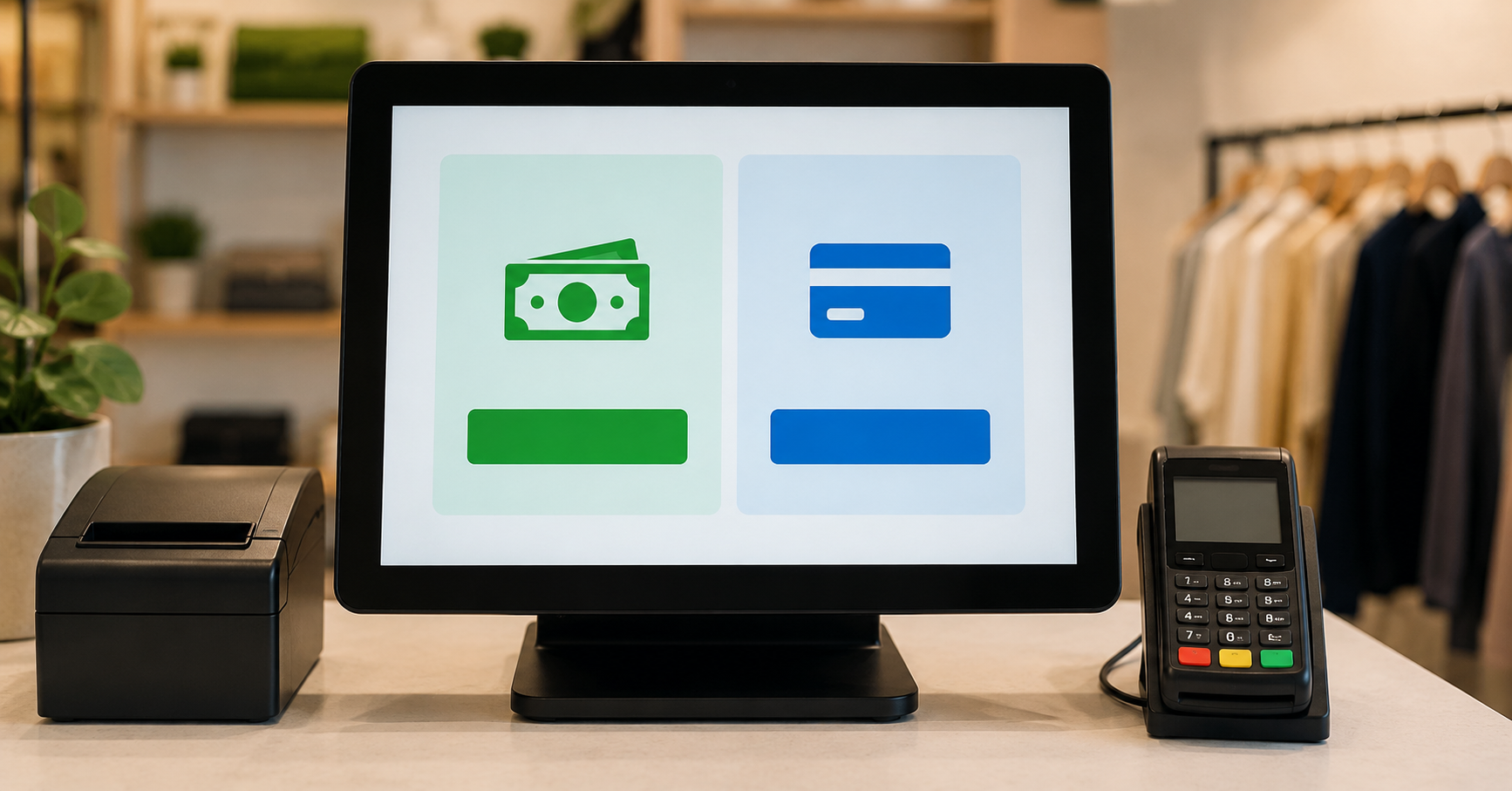
Dual pricing means you display two prices for every product or service — a cash price and a card price — at the point of sale. Both prices are visible before the customer makes a payment decision. There’s no surcharge line on the receipt because there’s no surcharge. The customer simply pays the price that corresponds to their payment method.
This is the legal distinction that makes dual pricing so powerful. You’re not adding a fee — you’re displaying two prices. Federal law has explicitly permitted merchants to offer different prices for cash and card since the Cash Discount Act of 1981. The Supreme Court reinforced this in 2017. As of June 2026, dual pricing is confirmed legal in every state, including Connecticut, Massachusetts, and Maine where traditional surcharging faces restrictions.
A properly implemented dual pricing system also handles debit cards automatically. The terminal reads the BIN range, identifies the card as debit, and applies the cash price — keeping you compliant with the Durbin Amendment without any manual intervention.
Side-by-Side Comparison
Registration: Surcharging requires 30-day advance notice to card networks and your acquirer. Dual pricing requires none.
Signage: Surcharging requires entrance and POS signage specifying the surcharge percentage. Dual pricing requires both prices displayed with equal prominence — the price tag itself is the disclosure.
Receipt: Surcharging requires a separate surcharge line item. Dual pricing receipts look like normal receipts — no surcharge line.
Debit cards: Both programs must treat debit at the lower price. A compliant dual pricing terminal handles this automatically; surcharge programs require manual or system-level controls.
State legality: Surcharging faces restrictions in some states. Dual pricing is legal in all 50 states.
Card brand fines: Both carry enforcement risk if implemented incorrectly. Dual pricing carries significantly less compliance overhead.
Which One Is Right for Your Business?
For most small and mid-size merchants, dual pricing is the better choice. It’s simpler to implement, carries less compliance risk, works in every state, and creates a cleaner customer experience because the pricing is transparent from the start rather than disclosed at checkout.
Surcharging can make sense in specific scenarios — particularly B2B environments where customers are sophisticated, invoice-based transactions are common, and cash isn’t a realistic payment option. In those cases the surcharge line on an invoice is less friction than repricing every SKU or service.
DropTheFee offers both programs, implemented correctly and compliantly. If you’re not sure which fits your business, a free processing analysis will give you a clear answer based on your actual transaction mix and volume.
Consult your payment processor and legal counsel to confirm compliance requirements specific to your state and merchant category.
Frequently Asked Questions
Can I run both dual pricing and surcharging at the same time?
No. Card brand rules prohibit running both programs simultaneously. You choose one structure and implement it consistently.
Does dual pricing require me to reprint all my menus or price tags?
For retail, your point-of-sale display handles it — both prices show on the customer-facing screen. For restaurants, some operators update printed menus; others rely entirely on the POS display. Your processor can walk you through implementation options.
What happens if a customer pays with a debit card on a dual pricing system?
A compliant system automatically identifies debit cards and applies the cash price. The customer pays the lower price. This is handled at the terminal level — no manual action required.
Is there a way to test dual pricing before fully committing?
Yes. A DropTheFee processing analysis can model exactly what your savings would look like under dual pricing before you change anything. No commitment required to see the numbers.
Ready to Choose the Right Program for Your Business?
Understanding dual pricing vs surcharging is step one. Step two is knowing which one fits your specific business, volume, and customer mix. Visit dropthefee.com or request a free processing analysis to get a straight answer — no sales pressure, no obligation.